


I promised in my first post to talk about games that were easy to learn, teach, and play. This selection is mostly meant for the gamer who hasn't done board gaming, or for the geek who wants to let his friends sample the hobby. Even if you're more deep into the hobby, there's a lot to enjoy from this selection, and you might find some good filler to play between your meatier selections. So no matter who are, if you've got some friends, some snacks, and maybe some beers, you'll find something compelling.
For this post, I've also included prices, primarily because a lot of the people I encounter aren't familiar with the price of gaming. I'd suggest using Amazon.com for purchasing, which is what I do, as they're the cheapest there are often come with free shipping. I also frequent a FLGS (or Friendly Local Game Store to the uninitiated) when I want a game right-now-right-away, but they're always more expensive.
1. King of Tokyo
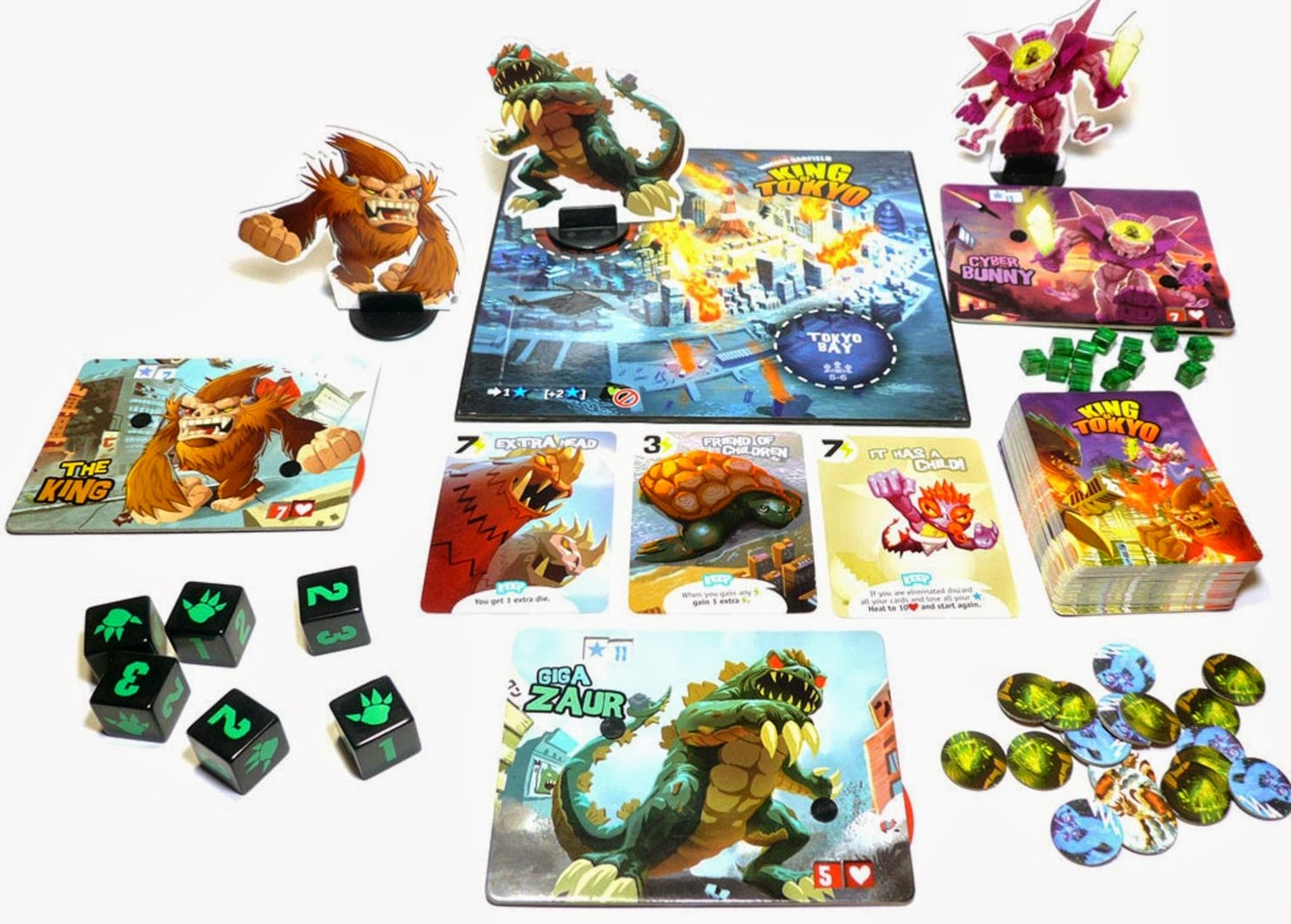 |
| All ready to wallop somebody. |
I'd also like to heartily recommend the expansion, King of Tokyo: Power Up! It is the best example of what an expansion should be, mostly because it's cheap, and also because it adds a lot of options to the game while adding almost no rules at all. It introduces some new special abilities, called Evolutions, which give each monster its own flavor, which is something I feel was missing from the base game. Expect to shell out about $30 for the base game, $15 for the expansion, and be playing a single game for up to—but usually less than—45 minutes. Great with four or five players, but it slows down if you add a sixth, and is fairly boring with only two.
2. 7 Wonders
.jpg "7 Wonders Game Play") |
| I "wonder" how they fit the rest of it on the table. |
of the 7 Wonders of the Ancient World, and you play your cards for resources, points, science, and military might, utilizing your wonder's unique ability while trying to complete it. The catch to the game is that each turn you pass your hand of unplayed cards to another player, so the cards you have in one turn aren't the cards you'll have to choose from in the next turn. It keeps you guessing, and good players quickly learn to get rid of the cards their opponents need. Admittedly, some of the mechanics are a little hard to grasp during your first game, but the second game always runs more smoothly. The other great thing about 7 Wonders is that the game plays exactly the same with three players as it does with seven, making it ideal for either a large or small group. It has a play time of 45 minutes once you're familiar with the game, and I find it usually takes an hour to play the first time around. Expect to pay about $35 for this title.
3. San Juan
 |
| Great game with such a boring box. |
Building up San Juan during the colonial period sounds boring, but I guarantee you that it is not. Each turn sees players choosing a role, such as "builder" or "carpenter" from a small selection, and then playing or gaining cards. Each card is a useful building that may give you a new ability, but each card is also the game's currency: to play one you need to discard other cards from your hand. It makes each decision an important one, because you need to prioritize what needs to go to the table and what needs to get discarded. Furthermore, you can only perform the actions that you and the other players choose. If you really want to play cards, you'll need to choose the appropriate role, but doing so may help the other players too much. In order to get ahead in San Juan, you'll need to anticipate what other players are doing and plan your role choice accordingly.
I'd be remiss if I didn't mention that there is a much more refined version of this game, called Race for the Galaxy. I chose to mention San Juan first because Race is a much harder game to learn, even though it is a far more rewarding and re-playable game. Both games will take about 45 minutes to play, play well with two to four people, and cost around $30.
4. Love Letter
 |
| I want to know how that dress stays up. |
5. Hanabi
 |
| "Hanabi" apparently means "fireworks" or some such. |
6. Suburbia

7. 1775: The American Revolution
 |
| I can't decide if this seems more or less boring than San Juan |
8. Agricola
This is easily the most popular game on the list, but it is also the most difficult to teach and learn (I would recommend doing the family version of the rules for your first game or two). Still, it is definitely worth the effort, and it is a very easy, intuitive game to play once you've learned it. And though it seems like the game is easy once you've learned the rules, it is a game full of tension and difficult decisions, fraught with frustration that then turns to joy when you manage to achieve something. Admittedly, the theme is kind of a hard sell. You're a 17th-century farmer trying to scrape a meagre existence off the land. Sounds boring, but it isn't. You'll try to gather resources in order to build fences to house animals, and you'll plow, plant, and harvest your fields. Each of your family members will give you an action on every turn, but they also need to eat. So to win you'll need to expand your family, but to expand you'll need to find a way to get more food. It all becomes a wonderful, harried mess as you try to expand your farm, feed your family, and try to gain new members. Your first game may take up to 2 hours, but after that you'll get a game in within an hour to an hour and a half. Engages two to five players equally well. About $50.
 |
| A Two-fer, for easy comparison! |
I thought I'd go with a two-player game for this one. All Creatures Big & Small is everything cool about Agricola, but less of it. Fewer rules, no cards, no family growth, and no feeding your people—this is nothing but the basics. The focus in this game is building up the number of animals in your farm, rather than growing crops. It plays in about 30 minutes and is a very simple, very fun game for two. It can also be found on the cheap, and if you get bored with this, there's a delightful expansion that really increases the re-playability of the title for less than the cost of a dinner out.
10. Pandemic
 |
| Play this game and become terrified of every sneeze. |
Honorable Mention: Powergrid
I won't say much, just that Powergrid is an incredible game. If you liked anything about Monopoly, you should definitely give this one a go. I'm not writing more about it because a longer co-op, Pandemic, definitely deserved a spot. Curse you, Pandemic! Two hours, six players, and about $40.
So there you have it. Ten--technically eleven--games, and each presents a little bit of a different look into most of the major genres and mechanics in board gaming today. Pick one up and give it a go. If you've played one of these or purchased one, let me know what you think of it in the comments.


